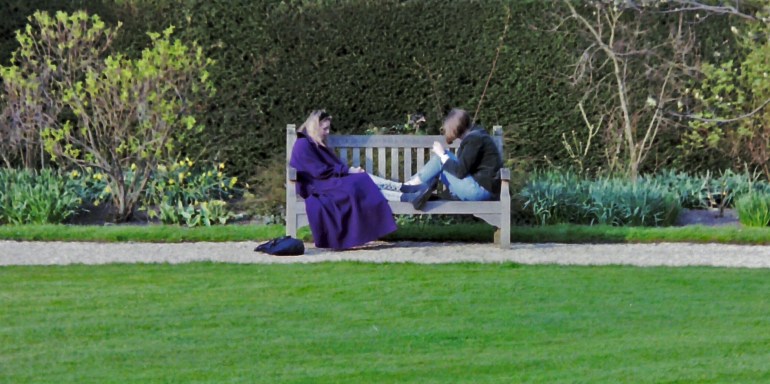
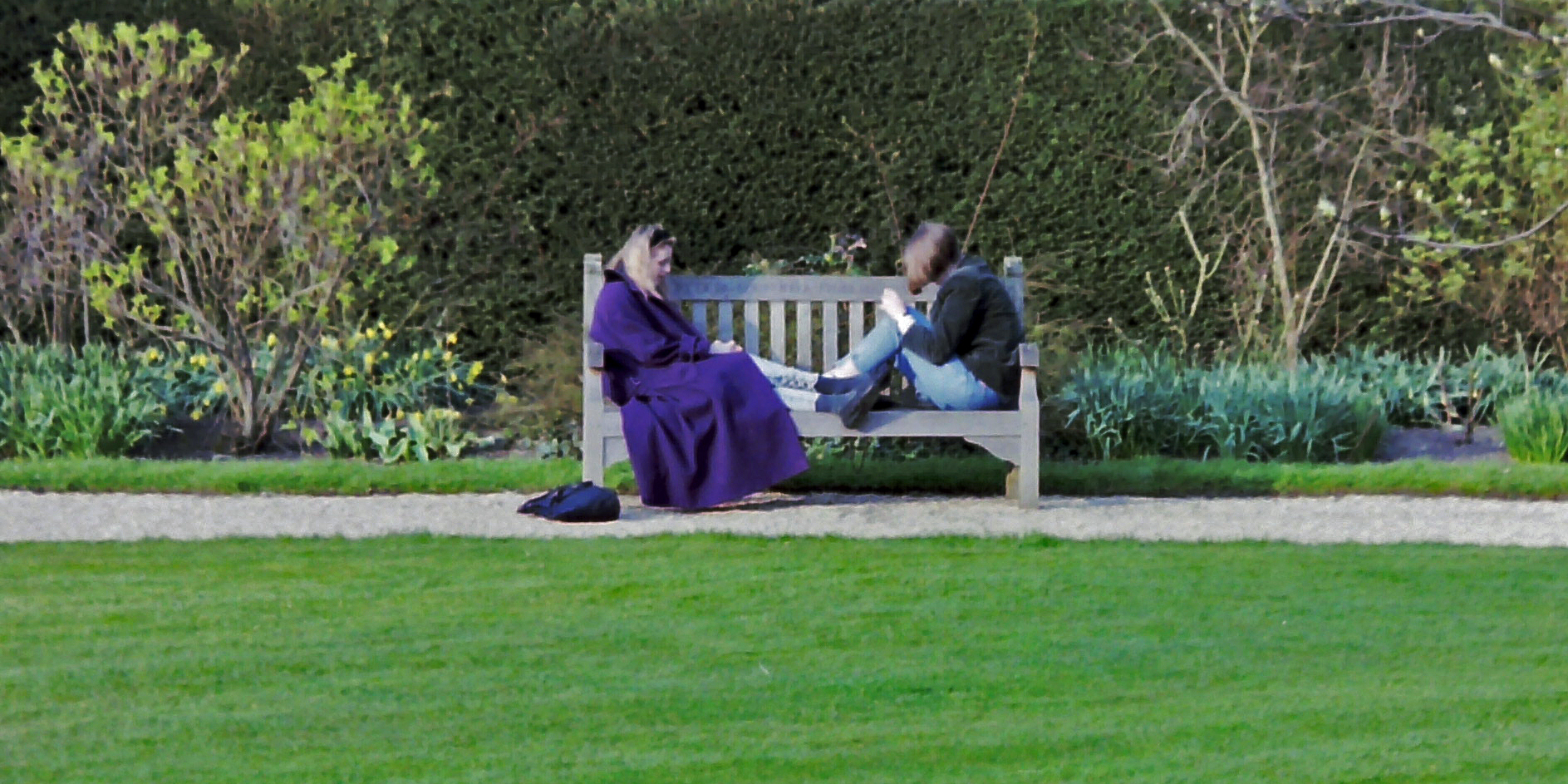
Friends talking on a park bench

The Half-life of Friendship

Friends talking on a park bench

Less Than One Per Cent


It is almost twenty-five years since I last saw Helene (name changed). A brief reconstruction allowed us to pinpoint the occasion: during her doctorate, around the turn of the century. After fifty, this is how we measure time.
Another calculation showed how little of our lives had been spent together. An academic year. A scattering of odd days thereafter. Less than one per cent. Otherwise, distance.

Chronos and Kairos


Despite all that potential for variance and divergence, conversation bubbled as if it had only just been paused. Small talk evaporated into larger thoughts about time and friendship. Helene told me about the difference between Chronos and Kairos: weighty concepts, metaphysical and full of meaning. The former is objective and quantitative; the latter subjective and qualitative. Kairos measures a moment’s value, not its duration. Our conversation wandered through Ecclesiastes and Eliot’s Four Quartets.


Helene asked whether, after such a long absence, punctuated only by occasional emails with all the richness and infrequency of letters, we could still be considered friends. It was an odd challenge for the scene we presented: two middle-aged people sitting on the corner of a set of neo-classical steps, looking out over the lawns of their alma mater, our heads close together like children sharing secrets. Look for us in the background of tourist photographs.


There was knowledge in her question, and another question beneath it: one with both surface and depth. Some traits of personality do not change.


Ordinarily, fifteen hundred miles separate us. Nigh on a quarter century has passed since we last shared air and a seat. Relationships, parenthood and epiphanies have unfolded outside each other’s regard. Those infrequent, letter-like emails always arrive after the moment has cooled. We are unacquainted with one another’s companions.


In a digital folder of retrieved files, from the era of low-resolution camera phones, I have a fuzzy image of her then-newborn son. What might she have asked me about being the son of a single mother?


She missed the moment my universe turned on its axis with the birth of the elder of my two daughters, and my submission to a life of servitude with the birth of the younger. What might I have asked her about fathers and daughters? My doubts, uncertainties and successes have gone unwitnessed, just as I have not witnessed hers.


She offered the concession that, had we lived closer, we would surely have participated more fully in each other’s lives. The truer concessions, of course, were that she had asked to meet and I had agreed without hesitation, and that with Chronos and Kairos she had handed me the key to answer her question. It was a courtly dance, allowing room for our conversation to breathe and for truths to expand.


She expertly catalysed my dilettante mind to ponder what makes some attachments last while others wither. Hence the half-life of friendship. What determines whether a connection decays to nothing or remains with us, scarcely affected by the passage of time?

The Archivist


Helene mentioned many of the people we had once known. I am still in occasional contact with two, and there is one other I might yet reach out to. The rest are only partly remembered, perhaps for a single incident, or else absent from memory altogether: erased, or eroded. Helene has kept in touch with more of them than I have. She could not recollect any friends from my other circles.


It turns out that she had become the archivist of our circle. No one should have to re-read their university poems. Yet writing, sketches and other ephemera I had thought lost—or safely consigned to the fire by my own hand—had been preserved. From a binder emerged a page torn from my diary and left in her college pigeonhole thirty years ago, in the age before mobile phones and email.


Deeper in the binder, among coffee-stained and smudged pages, there was an introduction and manifesto for our circle. I had given titles to everyone: some perceptive, some adoring, most now incomprehensible. It was a forgotten act for forgotten people. A list of strangers, as much as the young man—saucer-eyed and enthralled by everything—who had written it.


There was symbolism in this too: she had returned these artefacts to the place from which they came.

What Endures


All of which brings me to the point of difference. Why did she, and a chosen few others, lodge in my memory while the rest did not? Certainly they did not all disappear at once, and for a time some could probably have been recovered, even if that event horizon has now passed.


Friendship, like the Earth, can be sedimentary and accretive, but also seismic and explosive. Somewhere across the landscapes of our lives there must be change, whether in the drift that reshapes a shoreline or the sudden appearance of a sinkhole.


People pass by us all the time and leave no lasting impression. How many baffling numbers clutter our address books? A contact from a conference never followed up; the friend of a friend, coffee promises well-meant but momentary. Half-lives of acquaintance measured in days, or in unanswered text messages. There are innumerable interactions whose only meaning is that we occupied the same space while the Earth continued to spin. Faces I saw every day for years in previous jobs now appear only through the clouded glass of fallible memory. Time—Chronos—is neither necessary nor sufficient.

Witness


The answer, I think, lies in a piece of wisdom from David Whyte: witness. Not limited by volume or recency, but shaped by significance.


Attachment deepens when we witness moments that matter in another person’s becoming, or when they witness them in ours. The more significant those moments, the more enduring the bond.


Friendship rooted in that fleeting one per cent is not about attending a wedding; it is about being present when two people fall in love. Not about standing before a finished artwork, but about seeing the first spark of inspiration in an artist’s eye before pencil ever meets paper. It is about being seen, and realising that some part of you has, if only for a heartbeat, been understood.


Which brings me, long after the moment of the question has passed, to my answer.


No doubt we have missed much, but our circle of friends was present for profound moments of change among ripening, unfinished beings. In those primordial landscapes it was a tectonic thrusting of material that will take longer than a lifetime to abrade.
Our company met almost every evening over three scholastic terms in 1993/94. It waxed and waned, beginning with myself and the Seeker (the title I gave him in the aforementioned introduction). We would smoke Davidoff Lights, listen to Louis Armstrong and set the world to rights. The company was very much the Seeker’s circle, he brought together a wild collection of artists, philosophers and poets, that waxed and waned until the inevitable pressure of exam season left only a few of us eking out our moments together.


From a certain moment Helene became a fixed point in the gloomy room around which we orbited. At the end, before we scattered forever, she, I, the Seeker and the Sorceress were left counting stars in a moon-washed summer garden. Life-defining moments happened that year. Those who flitted in and out have left only fragments, an incomplete fossil record that resists interpretation. Those who truly put themselves into that pot of personalities and potential are the ones I remember. Some—a precious few—I still label with love, though we have not spoken in years.


The Quality of Time


Kairos, often associated with archery, gives us fewer significant moments to aim at as we age. Choosing to switch jobs is not as cataclysmic to the psyche as getting a first job. A later love may last “til death do us part” and may contain both profundity and longevity. It is not a first love.


Between the two lies the weight of age, experience and learned resilience. Mountains having grown and valleys having been cut, it becomes a harder, slower process for our personalities and outlooks to change than it was in our formative years. Harder, too, to witness that change without the investment of years.


All of which is to say that whether a friendship can survive a quarter century of separation is a complex equation. Its terms include what we witnessed of one another while we were together, what impression those instants made, and how many of them there were. Our own receptiveness modifies every term. Beyond a certain tipping point, some people can never be forgotten and our attachment to them is never wholly relinquished.


Distance may mean that we are not friends by some measures: frequency of communication, dependable presence, the continued role of witness across the years. Yet the connection remains. For Helene and me, a thread not frayed or withered by time bound us to sit on the steps of the Eagle Gate, look out over the Backs and talk until the cold of the stone seeped into our ageing bones.


Chronos or Kairos? How much time we spent together is not the point. It is the quality of that time, what we made of it, and what it made of us in those burgeoning weeks when we were still becoming ourselves. Time apart may have scuffed and scratched the surface of that edifice of attachment, but it remains standing among the fields and forests of our lives.


I expounded parts of this as we meandered into other subjects and lost ourselves in a town we had once known blindfold. My mind moves more slowly now; the fuller connections and the contentment with my answer came only weeks after we met.


Helene suggested that I am a good listener. She is wrong. I am a selfish listener, a thief. My attention is conditional on the thoughts my interlocutor sparks, the pretty lines for poems that arise, the threads that may one day produce stories: borrowed knowledge that may become a blog post or an essay.


My listening, too, is for quality rather than quantity. In this case it was so welcome, so rewarding, that I forgot to take any pictures of us together. I suppose, instinctively, I was certain that I would not forget.

End

For more of my writing check out my bibliography

Publication Announcement – Acts of Rebellion

AI generated visualisation of Sorcha and Samir from Acts of Rebellion by Ali Abbas

Acts of Rebellion is published today by the good people at Singapore Unbound, in their journal Suspect.

The origins of this story are a patchwork quilt. I have borrowed liberally from those around me in my university days, both my own alma mater of St Johns, and Homerton, home to many dear friends. 

At its heart are my memories of Armand & Evi, both post grads. Their relative maturity and beautiful romance gave them a palpable aura, a sense that we were in the presence of something greater. He (A) was Turkish. She (E) was Greek Cypriot. A forbidden love that outstripped your Montagues and Capulets. 

I recast them into a Pakistani origin Muslim boy (Samir) and a Northern Irish Catholic girl (Sorcha). Proximity makes the latter a little more accessible to me than Greece/Turkey. The former is home territory. 

I modelled Sorcha’s look, if not her life, on a friend of a friend, someone whose social circle intersected with mine. She was exquisite in a way that leaves an impression that lasts thirty years. Sorcha’s mannerisms are more recent, drawn from listening closely to a colleague (I told her why). 

Samir’s look I modelled on a chap I met on my first day at university. He left me an introductory note headed by a beautifully scripted greeting in Arabic. He was a medic so I barely saw him again over the next three years. For the story he wears my leather jacket.  

Evi died of breast cancer the year after I graduated. If you have read my story “The Book of Condolence”, the opening and closing moments, with the narrator deciding what to write in the titular book, are purely autobiographical from Evi’s memorial service. The rest of course isn’t. 

Threads from those lives and the geography of Cambridge are drawn together to make “Acts of Rebellion”. I should note here that during the 90s Homerton was a teacher training college, I understand it has evolved significantly since then.

I’m deeply grateful to Suspect for publishing it, and to Faith and Sharmini in particular for their sensitive and thoughtful editing. 

I used the WordPress AI image generator for this post. It took two prompts to get it right.

END

Head over to my author page to see what else I have written

Jaw Jaw and the Censure

IMG_3236

The Hindustan Times reports that Indian Prime Minister Narendra Modi is likely to address the senate of the University of Cambridge during his three-day visit to Britain in November. This has caused considerable consternation among those currently attending the University, whatever their capacity, and among alumni. The letter at the end of this link is addressed to the Vice Chancellor of the University requesting that he withdraw the invitation. It cites the reasons why such a person should not address the University, among which are his complicity in mass murder, and his systematic silencing of dissenting voices. As an alumnus I have signed the letter. I urge any fellow Cantabrigians reading this blog to consider doing so also.

When I promoted the letter on Facebook it drew two interesting observations from two friends of mine, both men of letters and learning, and in friendships that persist and thrive despite significant differences in our political leanings. The first observation was on whether this action constitutes an act of censorship. This friend is unwavering in his belief that freedom of speech should never be constrained, no matter how hateful the message, or the messenger, as this is a route to, and symptom of a more insidious tyranny. My other friend brought a considered tone of both treating a foreign dignitary with respect, and tempered this with a healthy dose of real politik. Alienating India, a key regional ally, and economic power would be damaging to our self interest. My friend and I learned the phrase “jaw jaw not war war” from the same history teacher decades ago. He went on to argue that by engaging with Mr Modi we have the opportunity to extend our influence over him, and over time draw him closer to our standards of openness and democracy.

I responded to both thus:

In the first instance the stance we are taking is not one of censorship, but censure. I admit though to relishing the irony of not letting a man who suppresses voices air his own. But as PM of India Modi does not lack for platforms from which he can spread his messages. The action is not to silence, but to withhold the cachet and implicit acceptance that goes with speaking at Cambridge when the speaker’s mores are so horribly at odds with the tolerance and intellectual freedom we so value.

Modi will undoubtedly speak at dinners hosted by Cameron and will be toasted by business leaders. The ballrooms and convention centres of Southall and Birmingham will be filled with Indian diaspora hanging off his every word, blind or willfully ignoring the atrocities in which he is complicit and hate mongering of which he is culpable.

Nor are the freedoms we love so cheap that we will hawk them in the bazaar to whoever passes with a purse full of copper. Have you been to India? The inequality there is of a scale you cannot comprehend if all you have seen is the local tragedy of the western homeless, sleeping in the rain shadow of skyscrapers. There an abject, withering poverty sits beside wealth beyond the dreams of avarice. Is it to those vaults of hoarded rupees we should sell our self respect.

Are we the world’s penniless drunk, sitting at the bar hoping the brash new money that walks in will buy a round for everyone? Are we the dissolute master returning to his suddenly wealthy manumitted slave with a shy smile, saying “I raised you up and only flogged you gently, and see how well you learned my lessons of violence and entitlement. Take me to lunch and tell me how you did it”?

I am not so readily bought. My Alma mater’s most precious asset is the ennoblement of mind it confers on those who pass through its halls and cloisters. People come to speak there to bask in its reflection. I hope the institution listens to the voices it has nurtured and withholds its light from this murderer of masses, from this silencer of voices.

And yet should we not hold him close? Talk to him rather than shun him, allow our sensibilities to seep into his own? It is a sentiment so self evidently true and right that it should immediately raise the hackles of suspicion. Look carefully at those who eschew estrangement from the things we despise and argue that we should bring our influence to bear. And then follow the sickly sweet scent of the money. It is as self serving a position to take in this instance as it is in our Prime Minister’s toadying with Saudi Arabia, and it is just as fruitless. I have not seen any evidence of influence bringing lasting political change to bear. More than that I think our influence in Britain is a myth we have spun to fill the emotional chasm caused by the loss of an empire. We keep close to other nations to pick their pockets or sell them our silver. Hard money and the consumption of things talks louder than the abstraction of influence. I suspect Churchill knew that in 1954 and his famous quote is just another pillar in his personal myth creation. Perhaps if he had been truthful he would have said, “more, more, not war war”.

END

More of my writing here

The Door I Never Opened

The Door I Never Opened

Footfalls echo in the memory

Down the passage which we did not take

Towards the door we never opened

Into the rose-garden.

TS Eliot – Burnt Norton

I cling to my regrets. They are milestones and millstones, showing where I have been, or the doors I did not open. Keepsakes, chains on snowflakes that bind my failing memory.

There are things I would change. Most are actions or decisions of such monumental personal proportions that I cannot unravel the consequences. Life, death, love and loss are contingent on those turning points. Best left alone, I think.

Little moments, almost inconsequential incidents also haunt me: a choice of words, a second’s hesitation. Given the chance to do these over I would take a different path.

This is one.

There is much I regret about that final year. My glittering academic career, punctuated with awards and scholarships, came crashing to earth. I ignored the syllabus and threw myself into night-long discussions on metaphysics, maths, syntax, and the recipe for the perfect mozzarella salad. I wrote a lot of bad poems. A lot, and really bad.  I spent hours tapping them out two-fingered, but I could not bring myself to spend a fraction of that time in the library reading about my course.

All that is set. Let it stay.

I’d change the two words I said to you one summer afternoon before we sipped elderberry cordial in the shadow of Woolf and Wittgenstein.

There is a lot I don’t remember about that year, twenty and some have passed since then. I do remember you. We smoked on the window seat in my room, our legs dangling towards the river and the Bridge of Sighs three storeys below. I should have been revising for my finals.

You asked me to turn you into a vampire. I bit your neck.

I remember how much you loved those windows. I remember I didn’t kiss you.

1931013_33671666361_3482_n

I remember the night four of us walked across the scholar’s garden. The moon through the branches striped the lawn. I took off my shoes and went third, it was our Abbey Road, or Belsize Park. “Do you remember, barefoot on the lawn with shooting stars?”

And I remember the day you were going on a trip upriver, and either I invited myself, or you insisted I go with you. There was a gang of your friends. Of them I remember nothing at all.

We watched the trees pass overhead from the bow of the boat, wading through the unreal beauty of Cambridge. You pulled me back as the others strolled to The Orchard tea room and said, “I do love you, you know.”

I said, “I know.”

Those words cut me today, while you have undoubtedly forgotten them. I don’t know what I was trying to prove, or what coolness and aloofness would achieve. A moment to be anyone but Han. I should have said anything else, I still don’t know what.

Who knows what it would change. I forget now if I ever saw you again after that day. Perhaps once in a fleeting goodbye and a promise to write. Perhaps not. Those facts might remain unchanged. But the burden of two careless words in my memory would be lifted, and I would tread a little lighter.

letters

END

If you are interested in my storytelling look here

More memories from college collated here